How we grade
Three ways to practise, and what each one asks before it counts. Every figure on this page is the one the product runs on, read from the same place the product reads it.
Skills
Twelve or twenty rungs to a star, by the skill's grade. Nothing takes a star away.
- The ladder
- A fixed number of rungs set by the skill's grade: twelve rungs for a skill from kindergarten to grade 3 and twenty for a skill from grade 4 to grade 8. A skill has one ladder, the same for every student who climbs it.
- The blocks
- Four blocks of equal length — three rungs on twelve and five rungs on twenty. The first three are facts, across every part of the skill at every level it has; the last is the skill used in a real question.
- A right answer
- Climbs exactly one rung. Every question served counts, and no question is a coin flip.
- A wrong answer
- Drops back to the start of the block the student is in and never below it, so a finished block is never lost. The working is shown, and nothing is scored.
- The star
- The top rung — rung 12 or rung 20. Climbing to it means every part of the skill answered right at every level, in four blocks with no slip inside any of them. It is earned the moment the top rung is reached, same sitting or weeks later.
- The next skill
- Opens at the start of the top block — rung 9 on twelve, rung 15 on twenty — so nobody waits on a star to move on.
- Once earned
- Kept. Nothing in the product takes a star back.
- Read and Write Numerals to 120 also asks written as digits; we do not test it yet.
- Understand Relative Sizes of Measurement Units also asks time; we do not test it yet.
- Identify Patterns When Multiplying by Powers of 10 also asks every digit moves down a place; we do not test it yet.
- Convert Units of Time also asks units that go by tens; we do not test it yet.
- Write numerals 0–10 also asks written in words; we do not test it yet.
- Write numerals 11–20 also asks written in words; we do not test it yet.
- Write numerals 0–5 also asks written in words; we do not test it yet.
12 of 12
20 of 20
Practice packets
Mixed review from the topic in play. No stars, no rungs — just what came back wrong, until it is right.
- What is in one
- A mixed set drawn from the skills a student has been practising in their current topic. A topic needs three skills in play before a packet is cut from it.
- How often, how many
- Every day with 10 questions to begin with. You set the rhythm (every day, every other day, once a week, off) and the size (6–40), and can hand out one extra whenever you like.
- The score
- Finishing a packet grades it, and you and the student both see how the first pass went. It is a record of that packet and nothing else.
- Corrections
- Every missed question comes back until it is right. After two misses on the same question the worked answer is shown, so nobody is stuck.
- Achieved
- A packet is achieved once every question in it has been answered correctly — not when it has been handed in.
- No stars, no rungs
- A packet never climbs a ladder and never earns a star. It is review of what has already been climbed, and it is graded on its own.
Fluency sheets
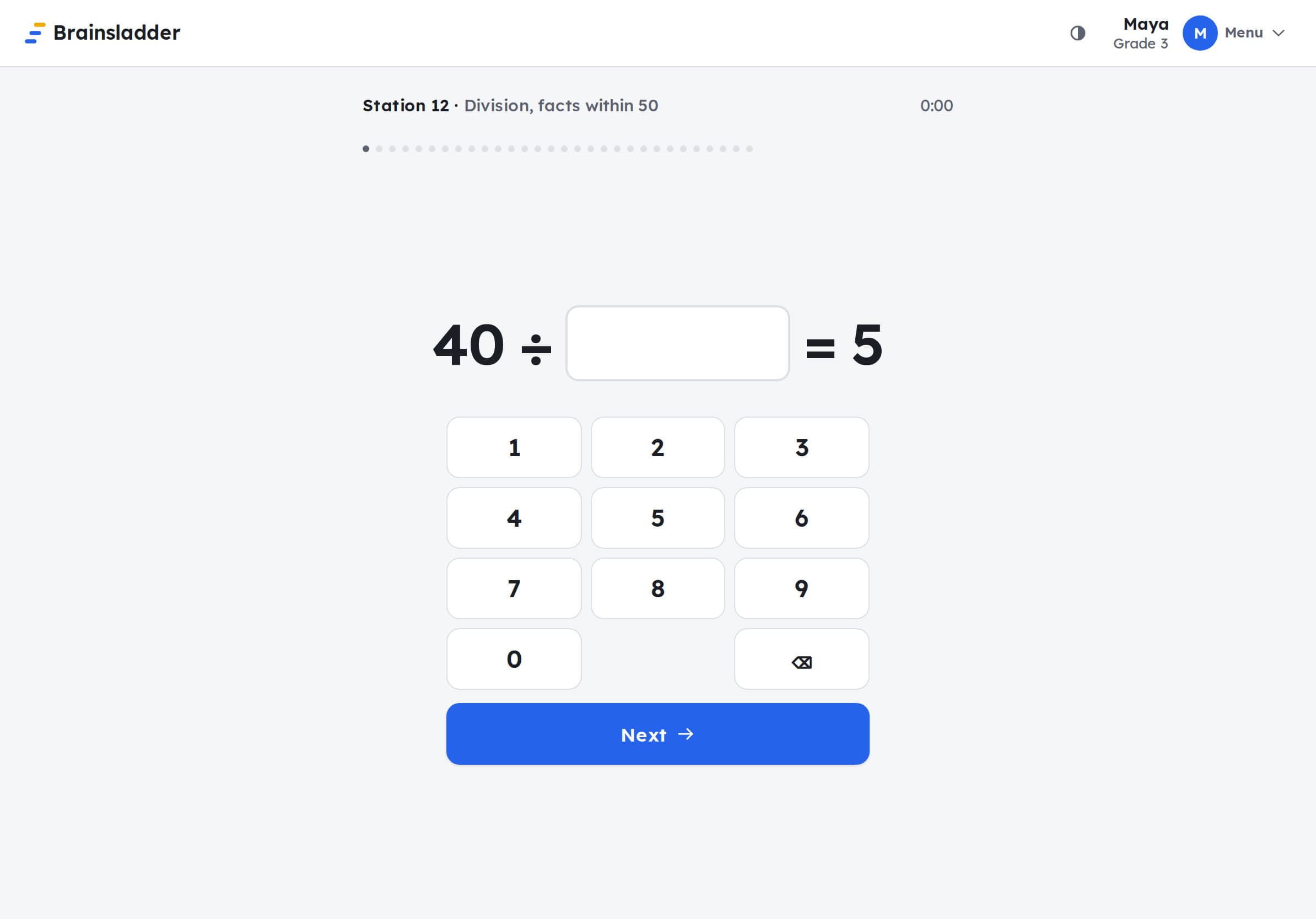
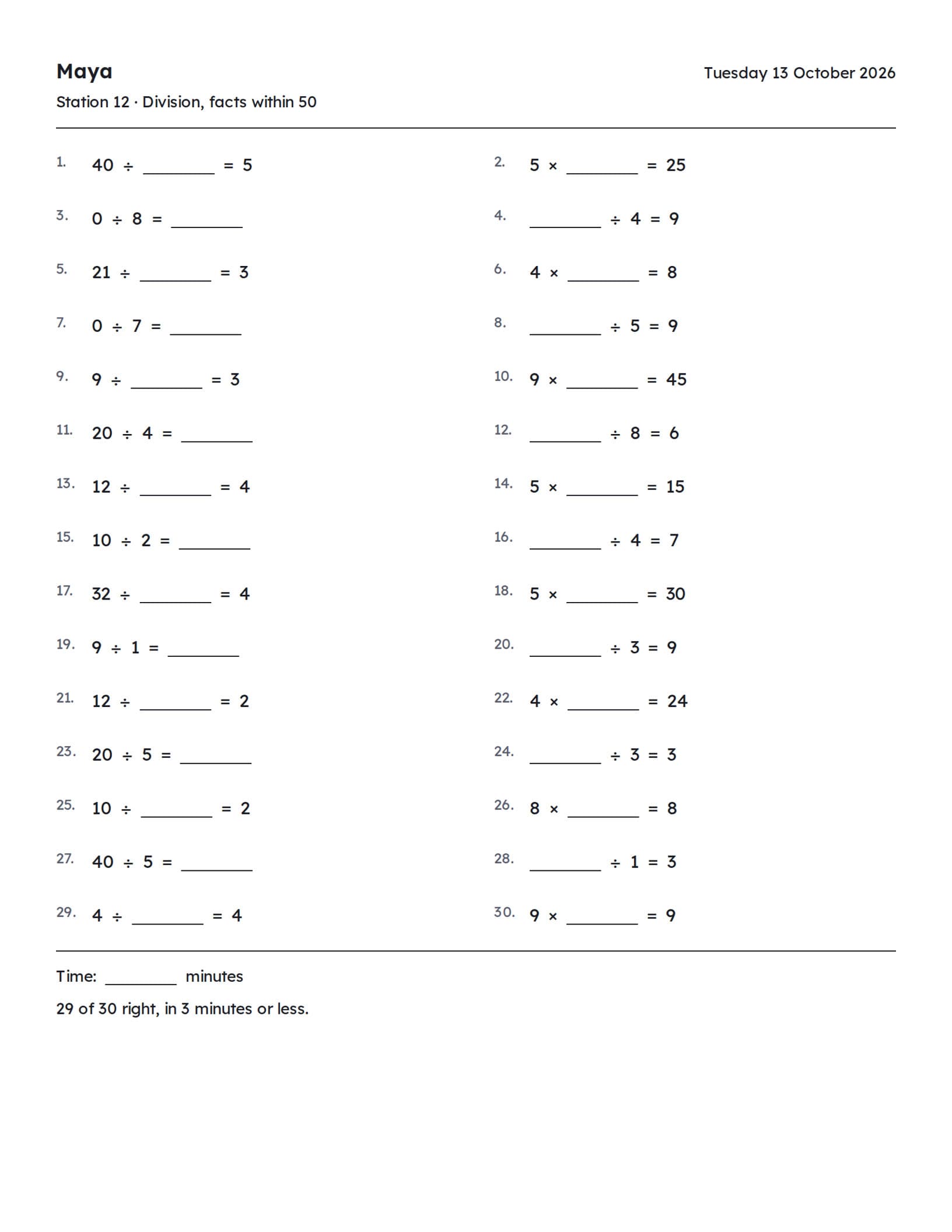
A timed sheet a day on a road of 36 stations. A sheet passes with all but one of the problems right inside the station's time.
- What a sheet asks
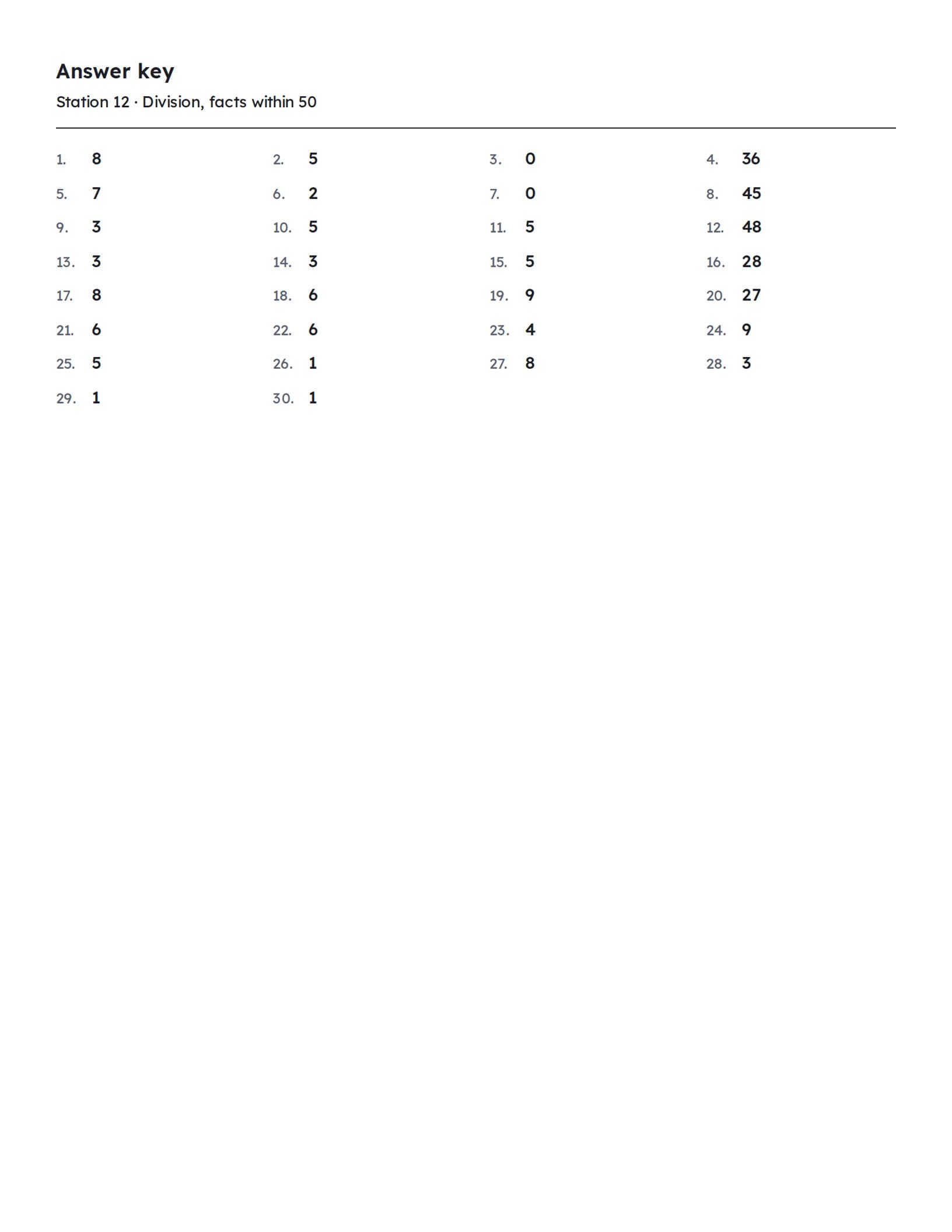
- One station's own kind of problem, in every form that station's standard names: the answer, and either number missing on a fact table, and on the two stations that ask in words, each question they ask. On the division fact tables (stations 12 and 18) a fact is also asked as the times fact it undoes, with the missing factor to find. Every sheet shows all of them, so a page is never one sentence repeated down it.
- Every kind of problem
- Each station names between four and twelve kinds of problem inside it — carrying and not, the bigger number first and the smaller, the missing number on either side, the ones place and the tenths — and every sheet deals every one of them.
- A pass
- All but one of the problems right inside the station's time: 29 of 30, 19 of 20, 11 of 12 or 9 of 10, depending on the sheet. On a sheet of 20 or more that is at least 95%. Screen and paper use the same bar, and a sheet at the bar passes every time. When a sheet falls short, the card names the kind of problem to practise, carrying for example, if that kind went wrong more than once. A score typed in from paper is judged on the number right and the time only.
- Moving on
- Two passes in a row at one station move the student to the next.
- Skipping ahead
- A first sheet at a station with every problem right, finished in under 50% of the time, moves them on at once. Nobody drills what they already have.
- Finding the station
- The first sheets start where the student's grade suggests, and are short. Pass one and the road tries a station higher; miss one and it tries a station lower. Kindergarten starts before station 1, with adding and taking away within 5.
- How many in a day
- At most three sheets. The next one is ready the moment one is finished, so a station can be passed in an afternoon — and the fourth waits for tomorrow.
- A sheet left unfinished
- A sheet is one sitting, so one left unfinished until another day is set aside, counts for nothing, and a fresh sheet at the same station starts with a fresh clock.
- Keeping it up
- When every station of an operation is passed, that operation joins the reviews. At most one review sheet comes back every 14 days, and the finished operations take turns, so fluency that was won is not quietly lost.
- Nothing is scored against a star
- A sheet is its own thing. It moves the student along the road; it never touches a ladder, a rung or a star.
The road, station by station
Addition
- 1within 10· 3 min
- 2within 20· 3 min
- 52-digit, no regroup· 6 min
- 72-digit, regroup· 6 min
- 143-digit· 6 min
- 19multi-digit columns· 6 min
Subtraction
- 3within 10· 3 min
- 4within 20· 3 min
- 62-digit, no regroup· 6 min
- 82-digit, regroup· 6 min
- 133-digit· 6 min
- 15multi-digit, across zeros· 8 min
Multiplication
- 9facts 0-5· 3 min
- 10facts 0-10· 3 min
- 11facts 0-12· 3 min
- 162-digit x 1-digit· 6 min
- 202-digit x 2-digit· 10 min
- 253-digit x 2-digit· 13 min
Division
- 12facts within 50· 3 min
- 17with remainders· 3 min
- 18facts within 100· 3 min
- 212-digit / 1-digit, long· 8 min
- 263-digit / 1-digit· 12 min
- 29/ 2-digit· 15 min
Fractions
- 22name and compare· 8 min
- 24add/sub, like denominators· 8 min
- 27unlike denominators· 9 min
- 30multiply· 8 min
- 32divide· 8 min
- 34mixed numbers· 8 min
Decimals
- 23place value, compare· 8 min
- 28add/sub tenths· 8 min
- 31add/sub hundredths· 8 min
- 33x whole number· 8 min
- 35x decimal· 10 min
- 36divide· 12 min
Each row is one operation and the stations it owns, in the order the road takes them. The time beside a station is what the whole sheet has to fit inside.
The daily goal
One finish line a day, set by you and met by any of the three.
- What it starts at
- 1 star a day, which is one skill mastered, every rung of its ladder climbed.
- What it can count
- questions, correct answers, stars — you choose which, and how many, per student.
- How far it goes
- Up to 10 stars a day, or 200 questions or correct answers.
- What meeting it does
- Says so, and offers to stop. Nothing closes and nothing is taken away: a student who wants to keep going keeps going.
- What a day is
- The same day everywhere in the product — on the goal, in the week's stars, on the report and in the spreadsheets. One clock, so two pages never disagree about which day a star belongs to.
What we never do
The other half of a standard: what the product has decided against.
- Take a star back
- There is no expiry, no decay and no re-test. A star earned in October is still there in June.
- Put a clock on a skill
- The ladder is never timed. The only clock in the product is on a fluency sheets sheet, where speed is the thing being practised and the student can see it counting.
- Let anything guess a sheet
- Every problem on a sheet is built from its station's own rule, and its answer is worked out before it is asked. Nothing writes one on the day.
- Count a wrong answer against them
- A miss costs height on the ladder and comes back as a correction in a packet. It is not scored, kept, or shown to anyone as a mark.
- Print how big the bank is
- How many questions sit behind a skill is not a measure of anything for a family, so no page claims it. What is public is every skill, and every explanation.
See it with your own student
14 days of the whole product — every skill, practice packets, fluency sheets, and the reports. No card, and no student email.